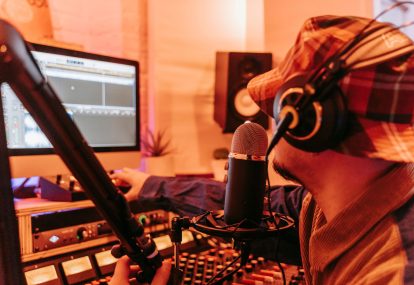
If you already record on Riverside, sooner or later you open the editor tab and wonder whether you need anyone else. That is a fair question. Riverside podcast editing has come a long way, and for some shows the honest answer is that the tool is enough.
I run an editing company, so read this with that in mind. But I would rather you hear when the software wins from someone who sells the alternative, because that is the only version of this comparison worth trusting.
What Riverside’s Editor Actually Does Well
Riverside started as a recording platform, and that is still the biggest reason its editor works. Because it records each person on their own track, the editor is working with clean, separate files from the start. A lot of what makes editing hard, like two people talking over each other on one muddy track, is simply not a problem.
On top of that, the editor handles the mechanical work. Editing by transcript, so you cut a sentence by deleting the words. Removing filler words and long silences. Audio cleanup. Automatic clips for social. An AI editing assistant that can do a rough pass for you. Five years ago, that was a few hours of a human’s week. Now a lot of it is a button.
For a solo show or a simple two person interview, recorded on decent mics, all inside Riverside, this genuinely covers most of what the episode needs. If that describes you, keep your money.
Where Riverside Podcast Editing Runs Out
An editor’s real job is a stack of small judgment calls. Which story should move up to the first five minutes. Whether that tangent is charming or a drag. Which guest answer is the episode and which is filler you are too close to hear. Whether the intro promises something the episode never delivers. Software can trim the pauses. It cannot tell you that minute 40 is your best moment and nobody will reach it.
It also struggles when the recording is not clean. A guest who joined from a phone, a track that dropped halfway, a room with echo, audio from outside Riverside mixed in. That is where a human earns their fee, because rescuing a messy file is a skill, not a setting.
And then there is time. Even with all the automation, someone still has to sit with the episode, make the calls, and own the result every single week. Our Descript vs hiring a podcast editor breakdown runs the hours math on a similar tool, and it applies here too: the software is cheap, but your hours are the real price.
A Simple Way to Decide
Riverside’s editor is probably enough if most of these are true. You record everything in Riverside. The audio is usually clean. The format is simple and repeats week to week. You enjoy editing, or at least do not mind an hour or two of it. And the show is not yet a channel that the business depends on.
A person is probably worth it if most of these are true. Your episodes need story decisions, not just cleanup. Recordings are often messy. You have video, clips and show notes on top of the audio. Your time is worth more than the edit costs. Or the show has to go out every week no matter what happens that week.
Most shows sit somewhere in the middle, and that is fine. A common setup is recording on Riverside, letting the tool do the first pass, and having a person do the judgment calls and the final polish. If you are weighing that, our podcast editing cost guide shows what each tier of human help actually buys, and the podcast editing services shortlist covers providers who are happy to work from your Riverside files.
A Note on Price
Riverside’s paid plans cost a small monthly fee, and editing features vary by plan. Check their pricing page before you decide, because tool pricing changes often. Whatever the exact number, it will almost always be cheaper than a person on paper. The real question is never the subscription. It is whether the tool can make the calls your show needs, and who makes them if it cannot.
Where We Fit
Bias declared: we edit podcasts for a living, and plenty of our clients record on Riverside. We would still tell a solo host with clean audio and a simple format to try the built-in editor first.
If you are not sure which side of the line your show is on, send us an episode and ask for the free 15- minute audio check. No pitch. We will tell you whether the tool is enough, and if it is, we will say so.
Podcast Engineers has been supporting podcasters since 2013. We’ve produced over 35,000 episodes across 350 plus shows.
Related Articles
The Podcast Production Process Fails at the Step You Did Not Hire For

Your Podcast Production Budget Has One Line on It. It Needs Six.

Three Podcast Case Studies. Not One of Them Had a Content Problem.