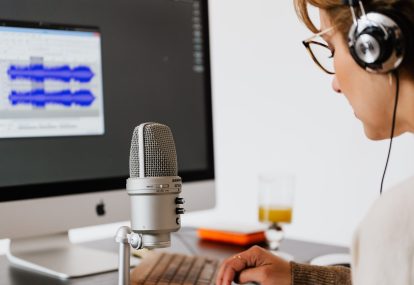
A founder I worked with last year spent his first six months obsessing over his microphone. He went from a USB mic to a Shure SM7B, then upgraded the preamp, then bought a cloud lifter, then added an outboard EQ, then redesigned his recording room.
His audio sounded great. His downloads barely moved.
A different host I started working with around the same time used a $90 mic and a closet for the first eighteen months. By the end of year one she had three times the audience of the first guy. Not because of her audio. Because of how the audio felt to listen to.
After producing 35,000 plus episodes across 350 plus shows since 2013, the thing we’ve watched most consistently is this. The audio that actually grows shows is not the most polished audio. It’s the audio that gets out of the way of the conversation.
I want to walk through what we’ve actually seen, because the gap between what podcasters think matters and what listeners notice is one of the wider gaps in this whole business.
What Listeners Actually Notice
Here’s the unromantic truth. Listeners don’t notice good audio. They notice bad audio.
If your show sounds clean, intelligible, and consistent, no one will email you to compliment the EQ. That’s not how it works. The audio gets out of their way and they engage with the content.
If your show has problems, listeners notice immediately. They might not be able to name what’s wrong. They might just say it “sounded off” or “I couldn’t get into it.” But the disengagement is fast and it’s quiet. They don’t unsubscribe with a complaint. They just stop hitting play.
Across our client base, the patterns are remarkably consistent. The shows that grow have audio that meets three thresholds. Beyond those thresholds, more polish doesn’t grow audiences. It just costs more to produce.
The Three Thresholds That Actually Matter
One. The voice is intelligible.
This is the bar. Can the listener understand every word without leaning in. That’s it. Intelligibility is the table stakes of podcast audio.
Most podcasters meet this bar with a decent dynamic mic, a close mic position, and basic EQ. You don’t need a $1,000 chain for it. You need a microphone you’ve positioned properly and a room that doesn’t ring like a bell.
The mistake we see most often is hosts using a condenser mic too far from their mouth in an untreated room. The mic picks up the room more than the voice and the result is technically clean but psychologically distant. The fix is closer mic position, not better gear.
Two. The levels are consistent.
This is the one that quietly drives listener fatigue and people don’t realize it. When your guest is loud and you’re quiet, the listener is constantly adjusting volume. When the intro music is too hot and the talking is too soft, every episode requires recalibration.
A consistent loudness curve across the whole episode and across the whole catalog is one of the single biggest predictors of listener retention. It’s not glamorous. It’s not what gets praised in audio circles. It’s what makes the show easy to listen to in a car or on a walk.
We do this on every client show. Auphonic helps. Manual riding helps more. But the principle is the same: the listener should not have to touch the volume knob during your episode, and your episode should sit at roughly the same loudness as the episode they listened to last week.
Three. The room sound is not embarrassing.
You don’t need a treated studio. You need a room that doesn’t sound like a room.
A small amount of reverb is fine. A lot of reverb makes listeners think the show is amateur, even when they can’t articulate why. Hard parallel walls, hardwood floors, and high ceilings are the enemies. Soft surfaces around the recording position are the friends.
The fix is usually $80 to $200 of acoustic treatment and a smarter mic position. Not new gear.
What Hosts Obsess Over that Doesn’t Move the Needle
The flip side. Things we watch hosts agonize over that almost never matter to audience growth.
The microphone brand. Once you’re past the budget-mic threshold, the difference between a Shure SM7B and an Electro-Voice RE20 is invisible to 99 percent of listeners. They’re both excellent mics. Pick one and stop second-guessing.
The mastering chain. Audio engineers can hear the difference between a clean broadcast loudness target and a mediocre one. Your listeners cannot. As long as the show isn’t crushed into distortion or whispered into inaudibility, the mastering is fine.
The post-production polish. Tightening every pause to its minimum, removing every breath, scrubbing every mouth click. We’ve watched hosts spend six hours per episode chasing this. The audience never notices. What the audience notices is whether the conversation has rhythm and whether the host sounds like a human being.
The intro music. It can be free royalty-free music. It can be 12 seconds long. As long as it identifies the show, it does its job. Custom-composed intros are a nice-to-have for established shows. They are not a growth lever.
We covered some of this in stop comparing your audio to Joe Rogan, but it bears repeating.
What the Data Actually Shows
We can see download patterns and listener retention curves across hundreds of client shows. The pattern is consistent.
Shows that hit the three thresholds (intelligibility, consistency, decent room) and release weekly with steady production grow.
Shows that exceed those thresholds with high-end production but release irregularly do not grow.
Shows that fall below those thresholds, even when they release weekly, do not grow.
The single biggest predictor of audience growth in our client base is not the audio quality at the top of the curve. It’s whether the production is consistent enough that listeners can rely on the show. The audio that sells is the audio that’s good enough every single time, not the audio that’s amazing every once in a while.
This is why we’ve leaned into talking about why most shows die at episode 21. Production fatigue kills more shows than bad audio ever has.
The Trap of Chasing Studio Polish
The pattern we see most often with founders is the gear upgrade as procrastination. The show isn’t growing the way they wanted. The instinct is to fix the audio. So they buy a better mic, then a better interface, then a better headphone, then redesign the room.
The audio gets better. The downloads don’t move.
This isn’t because the audio doesn’t matter. It’s because they were already past the threshold where audio quality was the bottleneck. The actual bottleneck was almost always content, consistency, or distribution. The audio was a comfortable place to spend money and feel like progress was happening.
When we onboard a client who’s been through this cycle, the first conversation is usually about pulling them back from the gear upgrade rabbit hole. The audio is fine. The show is fine. What’s missing is releasing every Tuesday for nine months and seeing what happens.
What We Tell Our Clients
For the host who’s deciding what to spend on audio: get to the three thresholds and stop.
For the host who’s already past the thresholds: stop spending on audio and start spending on consistency, content depth, or distribution. The audio is no longer the lever.
For the host who’s thinking about hiring a production partner: the question is not whether your audio could be better. The question is whether your time is better spent on the show itself or on the production around it. We covered the math in the real cost of DIY production.
The Audio That Sells
The audio that actually sells, after 350 plus podcasts of watching this play out, is the audio that meets the bar week after week and then disappears. Listeners forget about it. They lock into the conversation. They subscribe because the show is reliable, not because the show is pristine.
That’s a less satisfying answer than “buy this microphone.” But it’s the one we’ve watched come true across more episodes than we can count.
If your show is over the threshold and the audio isn’t the problem, happy to take a look at your workflow and tell you honestly where the actual growth lever is. We’ve helped 120 plus recurring clients figure this out and the answer is rarely what people expect coming in.
Related Articles
Outsource Podcast Editing First. Then Stop and Look Before You Hand Over Anything Else.
Your Listeners Can’t Hear Your Microphone. They Can Hear Your Pacing.
Branded Podcast Agency: Most Companies Buy the Wrong Tier