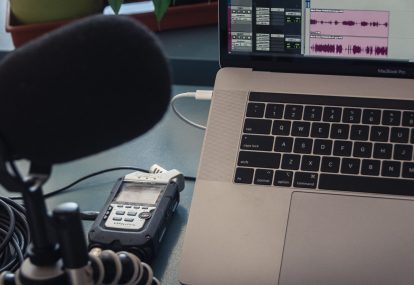
Every few weeks someone sends us a question about microphones. Should they upgrade from the $100 one to the $400 one. Would a better interface help. Is it worth treating the room.
Sometimes yes. But we have a confession from the production seat: most listeners cannot tell the difference between those two microphones on a phone speaker in a moving car. What they can tell, within a few minutes, is whether the episode is moving. Podcast pacing is the thing people feel and almost never name. They just say a show is “a bit slow” and quietly stop pressing play.
Nobody Has Ever Left a Review About Your Microphone
Think about the last podcast you stopped listening to. Not one you disliked. One you drifted away from. Was it the audio? Probably not. More likely it was the third episode in a row where the first eight minutes were catch-up chat, or the guest who answered every question twice, or the host who summarized what the guest just said.
That is pacing. It is the space between the good parts, and every show has more of it than the host thinks. Hosts hear their own episodes as a memory of a good conversation. Listeners hear them as a stranger with other options one tap away.
What Slow Actually Sounds Like
Slow is rarely one big problem. It is a dozen small ones that stack:
- The cold open that takes four minutes to get to a reason to stay.
- A story told twice, once badly and once well, with both versions kept.
- Three “great question” warmups before an answer starts.
- The tangent that was a blast in the room and means nothing to someone who wasn’t there.
- Long silences while someone thinks, left in because cutting them felt rude.
None of these are mistakes in the recording. They are normal human conversation. The edit is where they get decided, and that is why we argue the real work of an editor is judgment, not cleanup. We made the case in more detail in is podcast editing worth it: a cheap edit and an expensive edit sound the same for five minutes, and pacing is most of what changes after that.
Pacing Is a Decision, Not a Length
This does not mean every episode should be short. Some of the best shows run two hours and feel quick. Some 20-minute episodes feel like a commute in traffic. Length is a number. Pacing is whether each minute earns the next one.
That is also why “just make it shorter” is bad advice. Cut the wrong four minutes and you lose the moment a guest opened up. Cut the right four and nobody notices anything except that the episode felt better. The difference between those two edits is someone listening like an impatient stranger and asking, at every point, would I still be here?
If you have a budget for your show and you are choosing between new gear and better editing, here is our honest ordering:
- Fix anything that is genuinely distracting: echo, a buzz, a guest on laptop speakers. That is a gear or room problem, and it is worth solving.
- After that, put the money into the edit. A decent $100 microphone with sharp pacing beats a beautiful $400 microphone with a baggy episode, every time.
- Upgrade the gear later, when the show has earned it and the edit is already doing its job.
We wrote out what each level of editing costs in our podcast editing cost guide, and if you are shopping for help, our list of the best podcast editing services explains what to ask so you know the person is editing for pacing and not just removing ums.
The Test You Can Run Tonight
Pick your last episode. Play it at normal speed, and every time your attention drifts, write down the timestamp. Don’t judge, just mark it. Then look at the list. Those timestamps are your pacing map. If there are more than three in the first fifteen minutes, your listeners are drifting there too, and most of them won’t come back to find out what they missed.
If you would rather have a second pair of ears do it, send us an episode and ask for the free 15- minute audio check. No pitch. We will tell you where it drags, what we would cut, and whether your microphone actually needs upgrading. Usually it doesn’t.
Podcast Engineers has been supporting podcasters since 2013. We’ve produced over 35,000 episodes across 350 plus shows.
Related Articles
Branded Podcast Agency: Most Companies Buy the Wrong Tier
Is Podcast Editing Worth It? The $200 Edit and the $800 Edit Sound the Same at First
Podcast Clips for Social Media: You’re Clipping the Wrong 40 Seconds